
Tarantulas Were Seen Using Urticating Setae Against Ants
New research documents how some tarantulas combine urticating setae and silk to defend themselves against ants, revealing a previously undocumented defensive behavior.
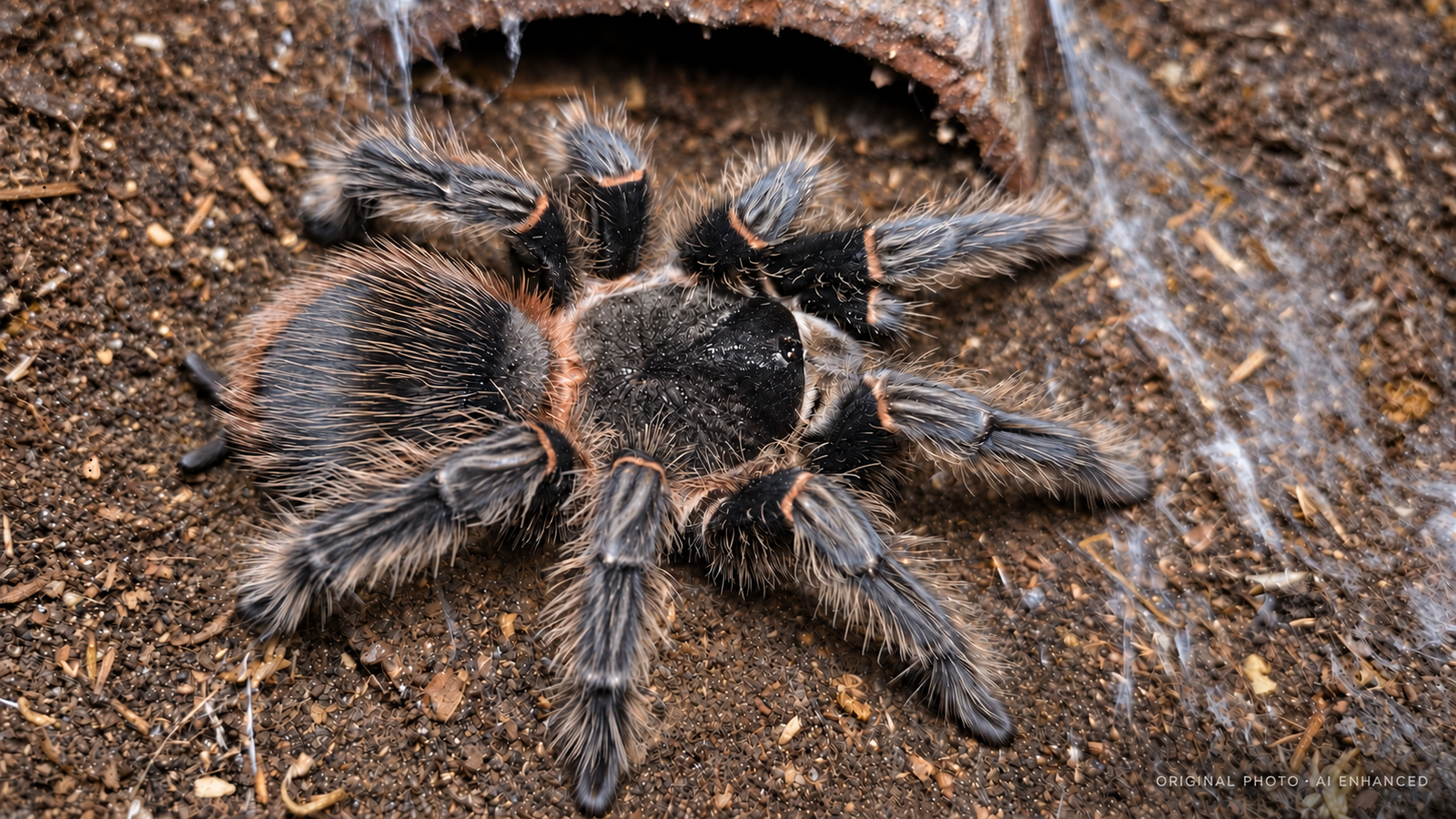
We know what happens when certain New World tarantulas feel threatened.
A hind leg moves across the abdomen.
Urticating setae are released.
It’s a defensive response familiar to many tarantula keepers.
But research published in August 2026 documented something different.
The target wasn’t a large animal.
It was an ant.
And instead of simply releasing their defensive setae, the tarantulas were observed combining them with something else.
Silk.
A Different Kind of Defense
In a study published in Scientific Reports, researcher Rogério Bertani investigated how several Brazilian tarantula species responded to encounters with ants.
The experiments involved eight tarantulas representing four species, tested across twelve trials involving army ants and carpenter ants.
During some encounters, the spiders displayed a defensive behavior different from the familiar response associated with releasing airborne urticating setae.
Instead, they rubbed the lower sides of their abdomens using short, downward and outward movements of their hind legs.
The setae were directed toward the ground.
And that wasn’t all.
The tarantulas also deposited silk, sometimes while releasing the setae.
Together, these materials created an obstacle for approaching ants.
What Happened When the Ants Made Contact?
Some ants became entangled in the combination of silk and urticating setae.
Their movements became restricted.
During certain observations, ants that came into contact with one another also became entangled.
But the researcher wanted to examine what was happening more closely.
Using scanning electron microscopy, he examined the defensive material attached to the ants.
The images revealed urticating setae, predominantly those classified as type I.
These observations provided physical evidence of how the setae interacted with the ants.
However, the experiments did not independently establish how much protection the silk and setae each provided.
Why Type I Urticating Setae Matter
Not all urticating setae are identical.
Their structures, locations and potential defensive functions can differ.
Type III setae, commonly associated with airborne defense in many New World tarantulas, are relatively long and slender.
Type I setae have a different structure.
They possess barbs oriented in opposing directions and can form clusters that are less easily dispersed through the air.
During the experiments, these characteristics allowed the setae to become entangled with ants and silk.
The findings suggest that tarantula urticating setae may have defensive functions beyond those commonly observed during encounters with larger animals.
But the research raises an even bigger question.
Could Ants Have Influenced Tarantula Evolution?
The researcher proposes that protection against predatory ants may have contributed to the evolutionary success of certain New World tarantulas.
Type I urticating setae occur in the tribe Theraphosini, a group that includes some of the world’s largest spiders.
Their structure and apparent defensive function against ants offer an interesting possibility.
Could protection against these smaller predators have helped certain tarantula lineages survive and occupy different environments?
For now, this remains a hypothesis.
The experiments documented a defensive behavior, but they did not establish that ant predation caused type I urticating setae to evolve.
Additional research will be needed to investigate that evolutionary relationship.
What This Means for Tarantula Keepers
Urticating setae are usually discussed in captivity as a defense mechanism that can affect keepers and other vertebrates.
This research adds another perspective.
Some tarantulas appear capable of directing particular urticating setae toward smaller threats while incorporating silk into their defensive response.
Importantly, not every spider reacted during the experiments.
The findings should not be interpreted as evidence that all tarantulas use this behavior or that every encounter with ants produces the same response.
The study involved a limited number of specimens from four species.
Nevertheless, it documents a previously unreported active defensive behavior against invertebrates.
It also highlights why studying tarantulas in a broader natural-history context can reveal behaviors that receive relatively little attention in captivity.
Sometimes, familiar structures still have unfamiliar functions.
RESEARCH ATTRIBUTION
ArachNeeds independently reports on this published research and was not involved in conducting the study.
Bertani, R. (2026).
Is predation by ants driving the evolution of tarantulas? First report of tarantulas (Araneae, Theraphosidae) actively using urticating setae against invertebrates.
Scientific Reports, 16, Article 23769.
DOI: 10.1038/s41598-026-64167-7