
TEST GUIDE — Terrestrial Tarantula Enclosure Basics
A good terrestrial tarantula enclosure does not begin with decoration. It begins with the animal.
Once you understand how the species uses the ground, substrate and retreat, the rest of the enclosure becomes much easier to plan. The goal is not to build the most elaborate setup. It is to give the tarantula what it needs, then let everything else work around that.
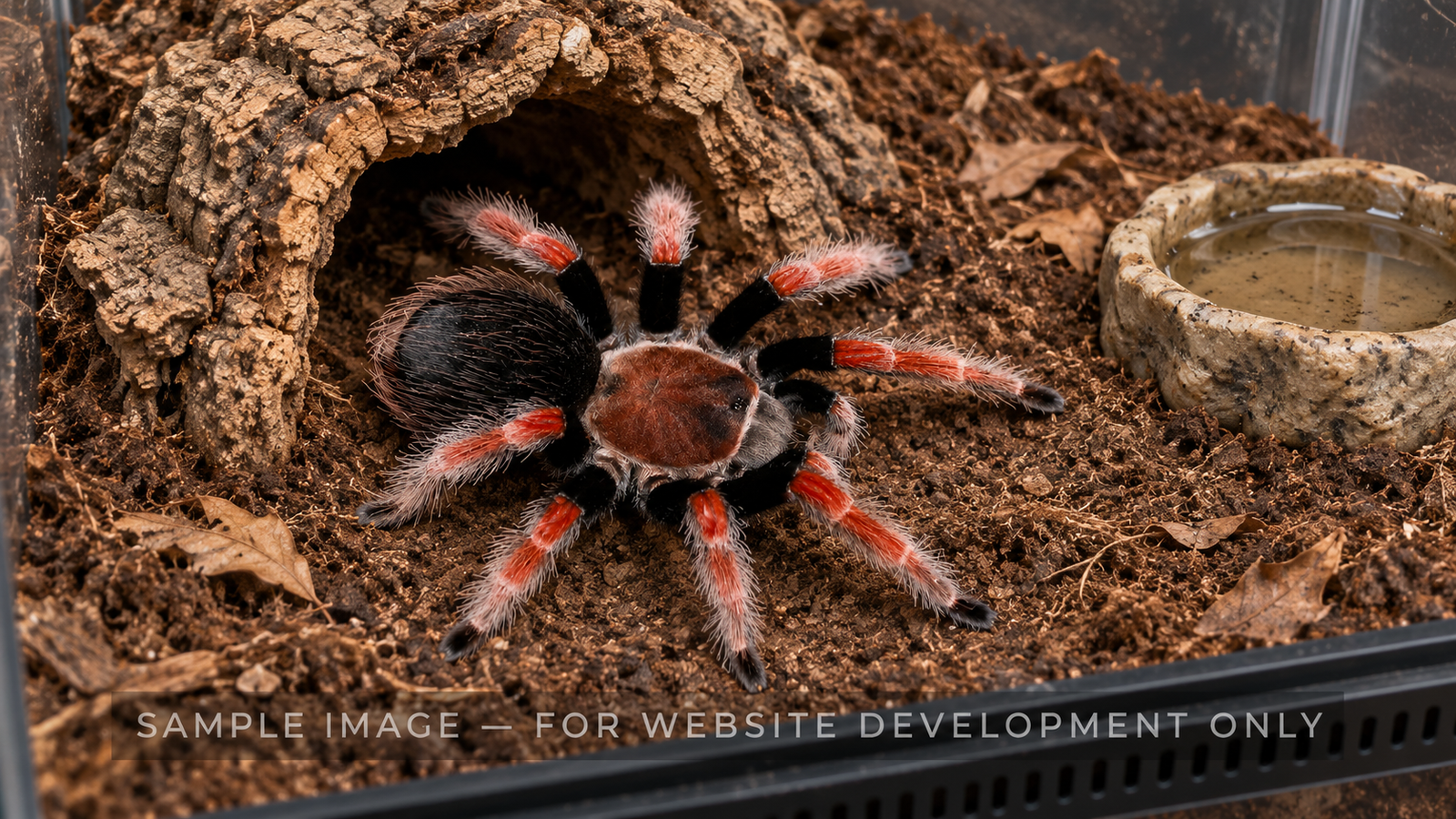
Start with the spider, not the enclosure
A good terrestrial tarantula enclosure does not begin with decoration.
It begins with the animal.
That sounds simple.
But it changes almost every decision that comes after it.
A terrestrial tarantula spends most of its time associated with the ground, a retreat, or the substrate around it. So floor space, usable substrate, security and shelter usually matter more than unnecessary vertical height or elaborate decoration.
The enclosure can look good.
It just needs to work first.
There is no single terrestrial setup
This is where enclosure advice can become misleading.
“Terrestrial” describes a general lifestyle, not one identical set of requirements.
Some species spend considerable time visible on the surface.
Others excavate.
Some enlarge an existing retreat.
Others may completely rearrange the substrate you carefully prepared for them.
So before deciding how the enclosure should look, ask a better question:
How does this particular species use its environment?
That answer should shape the setup.
Build from the ground up
Start with the substrate.
Not because substrate makes the enclosure look natural, but because it is part of the enclosure’s structure.
A useful substrate gives the tarantula secure footing and, where appropriate, something it can excavate or modify.
For species that burrow or reshape their retreats, depth becomes even more important.
A thin decorative layer may look finished from the outside.
To the spider, it may offer very little.
The exact substrate and moisture strategy should depend on the species, but the basic principle remains the same:
Give the animal substrate it can actually use.
Then look upward
A terrestrial tarantula can still climb enclosure walls.
That matters.
Heavy-bodied terrestrial species are not built around an arboreal lifestyle, so excessive open height can create unnecessary consequences if the spider falls.
The answer is not to make the enclosure tiny.
It is to use the available space intelligently.
Adequate substrate depth reduces unnecessary vertical distance while also giving the animal more usable ground beneath it.
Hard objects deserve the same attention.
A decorative stone may look harmless until it becomes the object underneath a falling tarantula. Veterinary guidance similarly recommends arranging enclosure objects so spiders cannot fall onto them or have objects fall onto the animal.
That leads to another useful rule:
If an object does not improve the enclosure, it does not automatically need to be there.
Give it somewhere to disappear
A retreat does not have to be elaborate.
A piece of cork bark, a suitable curved hide, or another stable structure can provide a starting point.
Then watch what the spider does with it.
It may excavate underneath.
It may move substrate toward the entrance.
It may web around it.
It may ignore your original plan entirely and create its own.
That is useful information.
The enclosure should not force the tarantula to live exactly where we want it to sit for viewing.
It should give the animal useful choices.
General spider-housing guidance likewise emphasizes housing appropriate to the spider’s behavior and requirements, with adequate cover, security and ventilation.
Moisture is more than a humidity number
It is tempting to reduce husbandry to a percentage.
But the enclosure is more complicated than a number on a hygrometer.
Species differ.
Life stages differ.
Substrates behave differently.
Ventilation changes how quickly moisture disappears.
Room conditions matter too.
So instead of trying to make every terrestrial enclosure match one fixed humidity value, look at the biology of the species and how moisture behaves inside the actual enclosure.
For many setups, thinking in terms of moisture availability and gradients is more useful than trying to keep every part of the substrate equally wet.
And moisture should not come at the expense of air exchange.
Ventilation still matters
A secure lid is important.
So is air exchange.
Those two requirements have to work together.
Ventilation openings should allow appropriate airflow while remaining small enough that the tarantula cannot escape through them.
This becomes especially important with small juveniles.
The spider does not care that an opening looked tiny to us.
If the carapace can fit through a gap, enclosure security deserves another look.
The British Arachnological Society’s housing guidance specifically lists enclosure security and adequate ventilation among the major considerations when choosing housing for spiders.
Keep water simple
Water does not need to become complicated.
For appropriately sized animals, provide a stable, shallow water dish with fresh water available.
University of Illinois veterinary guidance similarly recommends a low water dish rather than a deep container.
Then manage the rest of the enclosure according to the species.
Do not assume that spraying everything is automatically better husbandry.
Do not assume completely dry conditions are appropriate for every terrestrial species either.
Again, start with the animal.
Practical enclosure or display enclosure?
Both can work.
A simple plastic enclosure can provide excellent husbandry.
A carefully designed display enclosure can do the same.
The price of the container does not decide whether the setup is good.
Neither does the amount of decoration.
What matters is whether the design continues to provide the things the animal actually needs.
Secure housing.
Usable substrate.
A suitable retreat.
Appropriate ventilation.
Access to water.
Space arranged around the spider’s lifestyle.
Once those are in place, aesthetics can come next.
And there is nothing wrong with making the enclosure beautiful.
The mistake is allowing appearance to replace function.
Watch what the spider tells you
The setup is not finished simply because the lid closes.
Observe what happens afterward.
Does the tarantula use the retreat?
Does it excavate?
Does it constantly modify one part of the enclosure?
Does it web around a particular area?
Those behaviors can tell you something about how the animal is using the environment you provided.
That is one of the reasons keeping tarantulas remains interesting even after the enclosure is built.
You are not only looking at the animal.
You are watching what it does with the space around it.
The principle is simple
There is no requirement that good husbandry has to look one particular way.
Simple can work.
Elaborate can work.
Naturalistic can work.
The important part is the order in which the decisions are made.
Start with what the tarantula needs.
Then build something you enjoy keeping.